The best Xfinity alternatives in 2026 are AT&T Fiber for most households that can get it, GFiber for the most predictable pricing, and Frontier Fiber for the lowest-cost fiber. Check fiber at your exact address first; if none serves it, compare T-Mobile 5G Home Internet or Starlink Residential against Xfinity’s five-year price lock.
Most people leave Xfinity for the same reasons. The bill climbs after the promotion ends. Older plans still carry data caps. Equipment fees add up. Gig plans can upload too slowly for video calls. Many households also feel stuck because Xfinity looks like the only wired option.
As one user on r/Starlink described:
“Recently, I discovered that COMCAST had doubled my office price over a two-year period to $580 per month. I negotiated to get the price back to a reasonable one ($180 for 300 Mbps). It was then that I realized what was going on. They were setting the price to whatever my tolerance level is.” Posted by u/MBCone
Takeaway: Comcast customers who don’t check their bills can see prices drift far above what Xfinity will accept once they push back, which is why the rate after the promotion matters more than the advertised one.
Weigh Apps has no affiliate relationships with any company listed. Rankings are determined entirely by research data and objective evaluation criteria.
This guide ranks seven alternatives on a published 50-point scoring matrix and compares each one with Xfinity’s current plans. It also shows how to confirm service at your exact address before you cancel.
What Are the 3 Categories of Xfinity Alternatives?
Xfinity alternatives fall into three categories. Fiber gives you matching upload and download speeds over a wired line. 5G home internet sends a cellular signal to a gateway you set up. LEO satellite reaches almost any address with a clear sky view. Fiber fixes slow uploads best, 5G is easiest to set up, and satellite reaches the most homes.
- Fiber: AT&T Fiber, GFiber, Frontier Fiber and Verizon Fios all offer symmetrical or near-symmetrical speeds with no data caps.
- 5G Home Internet: T-Mobile 5G Home Internet and Verizon 5G Home Internet are fixed wireless access (FWA) services that need no installation visit.
- LEO Satellite: Starlink Residential uses low-Earth-orbit satellites, which makes it a fit for rural homes and backup lines.
Fiber availability is growing fast. About 84.6 million U.S. addresses had fiber available at the end of 2025, including about 11.8 million added that year (Fiber Broadband Association via Axis Intelligence, 2025 data).
Three of the seven alternatives share one owner. Verizon owns Verizon Fios, Verizon 5G Home Internet and Frontier Fiber, after its Frontier acquisition closed on January 20, 2026 (Verizon, 2026).
If your address has fiber, fiber is usually the upgrade. If it doesn’t, you are choosing between 5G’s lower price and Xfinity’s steadier wired connection.
How Do the Top Xfinity Alternatives Compare at a Glance?
AT&T Fiber leads this ranking with 41 of 50 points, and GFiber follows with 39. Fiber options take the top four places because they outscore every wireless option on upload speed. The 5G and satellite options rank lower, but they reach more homes and need no technician visit. The table below shows each provider’s category, best fit and main trade-off.
| Rank | Company | Category | Best For | One-Line Summary | Key Capabilities | Primary Strength | Key Limitation |
|---|---|---|---|---|---|---|---|
| 1 | AT&T Fiber | Fiber | Remote workers inside AT&T’s footprint | AT&T Fiber is the highest-scoring Xfinity alternative in 2026 for households that can get it. | Symmetrical up to 5 Gig, no cap, no equipment fee | Top ACSI 2026 fiber score (79/100); #1 in two J.D. Power 2026 regions | 12-month promos rise afterward; installs can take weeks |
| 2 | GFiber | Fiber | Households wanting a fixed bill | GFiber is the most predictably priced Xfinity alternative in 2026. | Symmetrical 1, 3 and 8 Gig; Wi-Fi 6E/7 included | Flat pricing with no promotional rate to expire | Reaches less than 1% of the U.S. population |
| 3 | Frontier Fiber | Fiber | Budget and rural fiber households | Frontier Fiber is the lowest-cost long-term fiber alternative to Xfinity in 2026 at 500 Mbps and above. | Symmetrical 500 Mbps to 7 Gig; guarantees up to 5 years | Fiber from $44.99/month (500 Mbps) with AutoPay | Mixed onboarding and billing reports |
| 4 | Verizon Fios | Fiber | Northeast households and Verizon mobile customers | Verizon Fios is a dependable fiber alternative to Xfinity for Northeast households in 2026. | 300 Mbps to 2 Gig; router included | Verizon ranked #1 in J.D. Power 2026 East (592/1,000) | Two Verizon pages list different prices; setup up to $99 |
| 5 | T-Mobile 5G Home Internet | 5G | Renters and no-install households | T-Mobile 5G Home Internet is the highest-scoring no-install Xfinity alternative in 2026. | Self-setup gateway, unlimited data, price lock up to 10 years | Top J.D. Power 2026 wireless score (659/1,000) | Low median uploads; CGNAT can break VPNs |
| 6 | Verizon 5G Home Internet | 5G | Verizon phone customers | Verizon 5G Home Internet is the best 5G option for Verizon phone customers in 2026. | C-band plus mmWave; router included | Tied for top non-fiber ACSI 2026 score (79/100) | Low uploads and higher latency than cable |
| 7 | Starlink Residential | Satellite | Rural homes and backup lines | Starlink Residential is the best Xfinity alternative for rural homes in 2026. | LEO satellite, unlimited Residential data | Reaches almost any address with a clear sky view | Less speed per dollar; hardware and congestion fees |
Which Xfinity Alternative Should I Choose for My Use Case?
Choose by your top priority. Remote workers should pick fiber, because fiber fixes slow uploads. Budget households should compare Frontier Fiber with T-Mobile 5G Home Internet. Phone customers should check their carrier’s home internet bundle. Rural households without fiber should look at Starlink Residential first. The table maps each priority to one provider and a fallback.
| Your #1 Priority | Recommended Tool | Why | Acceptable Alternative |
|---|---|---|---|
| Fast uploads for remote work | AT&T Fiber | Symmetrical speeds and the widest fiber reach | GFiber, Frontier Fiber or Verizon Fios |
| Lowest long-term monthly cost | Frontier Fiber | Fiber from $44.99/month (500 Mbps) with AutoPay and a 4-year guarantee | T-Mobile 5G Home Internet |
| A flat bill with no promo to expire | GFiber | No promotional rate; GFiber says its 1 Gig price has not changed since 2012 | T-Mobile 5G Home Internet (price lock up to 10 years) |
| You have a Verizon phone line | Verizon Fios | Mobile + Home discounts and setup-fee waiver | Verizon 5G Home Internet |
| You have a T-Mobile phone line | T-Mobile 5G Home Internet | Voice-line discounts | Any fiber option at your address |
| Gaming and low latency | Any fiber option at your address | Wired connections showed lower latency than 5G or satellite in the data reviewed (Xfinity cable 16.6 ms vs Verizon 5G Home Internet 34.4 ms, CableTV.com, 2025; Starlink 39 ms, Ookla, Q1 2026) | Stay with Xfinity |
| Renting or no installation | T-Mobile 5G Home Internet | Self-installed gateway | Verizon 5G Home Internet |
| Rural or Xfinity-only address | Starlink Residential | Reaches almost any address with a sky view | Frontier Fiber where available |
| Backup during outages | Starlink Residential | Runs independently of cable lines | AT&T Fiber with Internet Backup |
1. AT&T Fiber: Best Overall Xfinity Alternative (Widest Fiber Reach)
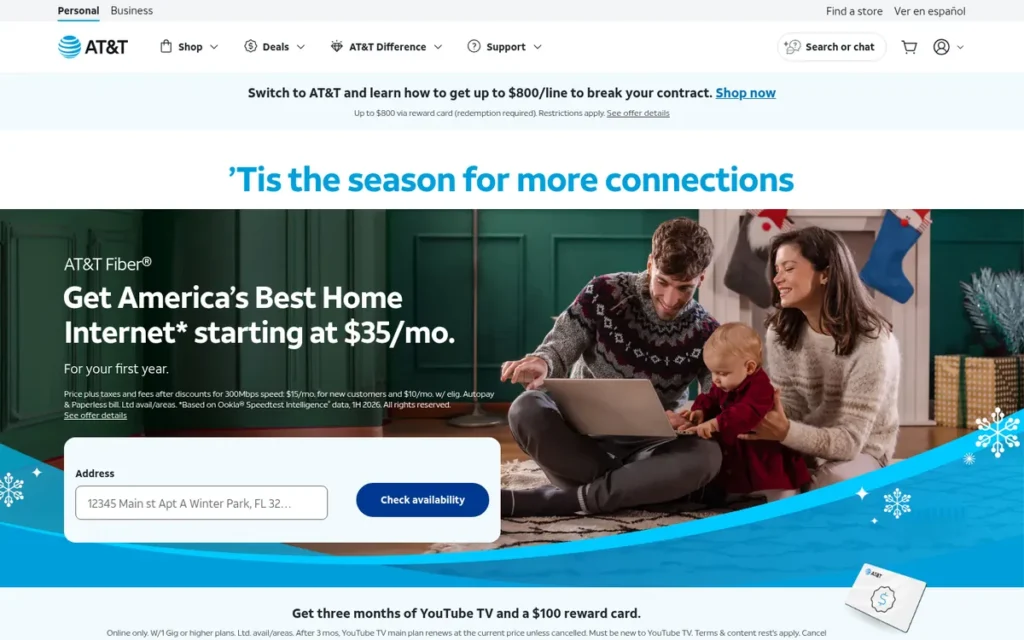
Category: Fiber, a wired connection over fiber-optic lines with matching upload and download speeds.
At a Glance
- Category: Fiber
- Best For: Remote workers and heavy uploaders inside AT&T’s fiber footprint, including former Quantum Fiber cities
- Price Range: $35–$60/month for 12 months on 300 Mbps–1 Gig, then about $50–$80 with AutoPay (Allconnect, 2026; secondhand); 5 Gig at $100, then $135 (AT&T, verified November 2026)
- Primary Strength: AT&T Fiber combines the top fiber score in ACSI 2026 with #1 finishes in two J.D. Power 2026 wired regions and the largest fiber footprint in this evaluation.
- Biggest Limitation: AT&T Fiber’s 12-month promotional prices rise afterward, and installations that need a new line can take weeks.
- One-Line Summary: AT&T Fiber is the best overall Xfinity alternative in 2026 for most households that can get it, offering symmetrical speeds up to 5 Gig, no data caps and the highest fiber score in ACSI 2026 (79/100).
- Last Verified: November 2026
Overview
AT&T Fiber is a fiber-to-the-home (FTTH) internet service with matching upload and download speeds up to 5 Gig and no data caps or equipment fees. It is built for Xfinity customers in its 36M+ location footprint who need faster uploads for video calls and cloud backups.
AT&T Fiber grew in February 2026 by absorbing Lumen’s Quantum Fiber areas. AT&T Fiber scored 41/50, the highest total in this ranking.
Key Features
- AT&T Fiber offers symmetrical speeds up to 5 Gig, though AT&T says a single wired device tops out at about 4.7 Gbps on the 5 Gig plan.
- AT&T Fiber has no data caps, no annual contract and no equipment fees (AT&T, accessed Nov 2026).
- AT&T Fiber includes ActiveArmor security at no extra cost.
- AT&T Fiber customers with eligible AT&T wireless plans can add Internet Backup, which switches to cellular during an outage.
- AT&T Fiber now serves former Quantum Fiber markets, including Denver, Seattle and Salt Lake City, after the Lumen deal closed on February 2, 2026 (AT&T, 2026).
Best For
AT&T Fiber is best for remote workers, creators and multi-user households in AT&T’s footprint who are leaving Xfinity over slow uploads or legacy data caps.
Pricing
AT&T Fiber’s only price verified on AT&T’s own site is Internet 5000 at $100/month for 12 months, then $135/month plus taxes, with limited availability (AT&T, accessed Nov 2026). Allconnect lists the lower tiers below (Allconnect, 2026); these figures are secondhand, so confirm them at checkout.
- AT&T Fiber 300 Mbps costs $35/month for 12 months, then about $50 with AutoPay.
- AT&T Fiber 500 Mbps costs $50/month for 12 months, then about $65 with AutoPay.
- AT&T Fiber 1 Gig costs $60/month for 12 months, then about $80 with AutoPay.
AT&T Fiber users on r/bayarea also report extra charges (accessed Nov 2026):
- AT&T Fiber costs about $10/month more without AutoPay, according to user reports.
- AT&T Fiber users report a $5 charge for paying by credit card.
- AT&T Fiber Wi-Fi extenders cost about $10/month, according to user reports.
Strengths
- AT&T Fiber scored 79/100 in the ACSI 2026 Telecom Study, up 1% and the highest fiber score for the fourth consecutive year (ACSI, 2026).
- AT&T Fiber ranked #1 in both the North Central (578/1,000) and West (595/1,000) wired regions of the J.D. Power 2026 U.S. ISP Satisfaction Study (J.D. Power, 2026).
- AT&T Fiber reaches more than 36M fiber locations after the Lumen deal and plans about 4M new locations in 2026, though those locations include business and partner sites (AT&T, 2026).
- AT&T Fiber switchers report big upload gains, such as “1g up and down vs 1G down and 35Mbs up with Xfinity” (u/jelorian, r/bayarea, accessed Nov 2026).
Users on r/googlefiber shared their experience:
“If I could get it I would have a long time ago. But having ATT fiber is just as good. Super overfill at 5 gig and I am loving having so much speed I can’t utilize it properly. And for half the cost” Posted by u/parabola19
Takeaway: For Xfinity customers outside GFiber’s small footprint, AT&T Fiber’s 5 Gig tier works as an equal substitute, giving them more symmetrical speed than they can use at a lower price than they paid before.
Limitations
AT&T Fiber’s most consequential trade-off is its promotional price structure. Rates rise after 12 months, for example from $100 to $135 on 5 Gig, and users report AutoPay and credit-card surcharges.
- AT&T Fiber installs that need new conduit or a line from the pole can drag on; one user reported “3 weeks and 10-15 phone calls and 6-7 site visits” (u/textisaac, r/bayarea, accessed Nov 2026).
- AT&T Fiber’s gateway has no true bridge mode, so users rely on IP Passthrough instead (r/ATT, accessed Nov 2026), and one user reported weekly modem lockups.
- AT&T Fiber quotes sometimes lose to Xfinity retention offers, according to Reddit users who were offered better terms to stay.
How Does AT&T Fiber Compare With Xfinity?
Xfinity’s current plans start at $55/month with a five-year price lock and unlimited data. AT&T Fiber gives symmetrical uploads, while Xfinity’s typical uploads run 35–300 Mbps (user reports, r/Fios and r/googlefiber, accessed Nov 2026). Xfinity’s five-year lock beats AT&T Fiber’s 12-month promotions on predictability.
Verdict
AT&T Fiber is the highest-scoring Xfinity alternative in this 2026 ranking (41/50), pairing the highest fiber score in ACSI 2026 (79/100) with the largest fiber footprint in this evaluation. AT&T Fiber leads GFiber by 2 points: it scores 8 more on double-weighted Availability and trails by 6 across True Cost, Terms and Reliability. Get a written quote for your tier and compare it with an Xfinity retention offer.
AT&T Internet Air is a separate fixed-wireless product for addresses without fiber. AT&T Internet Air was not ranked because no plan data could be verified.
2. GFiber: Most Predictable Fiber Pricing
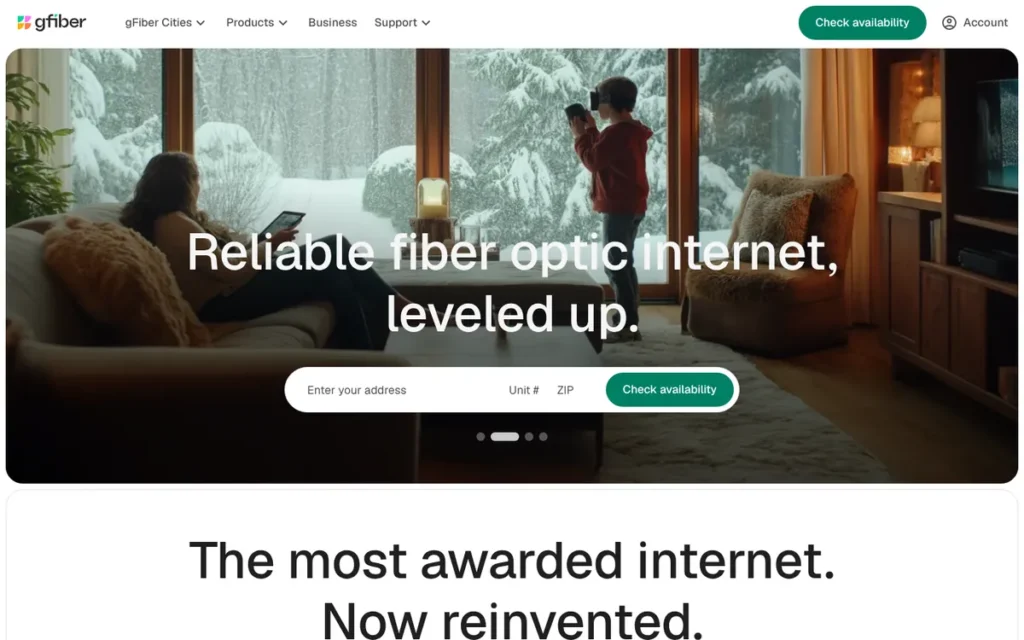
Category: Fiber, a wired connection over fiber-optic lines with matching upload and download speeds.
At a Glance
- Category: Fiber
- Best For: Households in GFiber metros who want a fixed bill with no price jump after a promotion
- Price Range: $70–$150/month (1, 3 and 8 Gig; verified November 2026; may vary by market; taxes and local access fee may be extra)
- Primary Strength: GFiber offers flat, promotion-free pricing with Wi-Fi equipment and standard installation included.
- Biggest Limitation: GFiber covers less than 1% of the U.S. population, so most Xfinity customers cannot get it.
- One-Line Summary: GFiber is the most predictably priced Xfinity alternative in 2026, offering symmetrical 1–8 Gig fiber at flat rates from $70/month and the highest J.D. Power 2026 score in this research (707/1,000, South region), but only in a small set of metros.
- Last Verified: November 2026
Overview
GFiber, formerly Google Fiber, is an Alphabet-owned fiber-to-the-home (FTTH) service offering symmetrical 1, 3 and 8 Gig plans at flat prices with no promotional rates. It is built for households in its small metro footprint who want a predictable bill and multi-gig uploads.
GFiber’s main constraint is availability, not quality. GFiber scored 39/50 and ranks second mainly because of its small coverage area.
Key Features
- GFiber offers Core 1 Gig, Home 3 Gig and Edge 8 Gig plans, all with equal upload and download speeds.
- GFiber includes a Wi-Fi 6E router and one extender on 1 Gig, and a Wi-Fi 7 router with two extenders on 3 Gig and 8 Gig.
- GFiber includes unlimited data, no contract, no equipment fees and free standard installation.
- GFiber includes battery backup on the 8 Gig plan and offers it as an option on 3 Gig.
- GFiber also runs Webpass, a fixed-wireless service for apartment buildings.
Best For
GFiber is best for households in its service metros who want symmetrical multi-gig speeds and a price that doesn’t change when a promotion ends.
Pricing
GFiber lists these flat prices as of November 2026, and prices may vary by market (GFiber, accessed Nov 2026):
- GFiber Core 1 Gig costs $70/month.
- GFiber Home 3 Gig costs $100/month.
- GFiber Edge 8 Gig costs $150/month.
GFiber says taxes and any local access fee may be extra (GFiber, 2026). GFiber also says its 1 Gig price hasn’t changed since 2012, which is a company claim.
GFiber has no intro discount, so an Xfinity promotion can cost less in year one.
Strengths
- GFiber ranked #1 in the wired South region of the J.D. Power 2026 U.S. ISP Satisfaction Study with 707/1,000, the highest score in this research (J.D. Power, 2026). GFiber does not appear in ACSI 2026, so its satisfaction score rests on this result.
- GFiber’s no-promotion pricing removes the post-intro price jump that Xfinity customers often complain about, a contrast Reviews.org drew with a writer’s own Xfinity increases (Reviews.org, accessed Nov 2026).
- GFiber users report steady speeds, such as “940 up/down on 1G in KC… very consistent” (u/OutlawFrame, r/googlefiber, accessed Nov 2026).
- GFiber includes Wi-Fi 6E or Wi-Fi 7 equipment and extenders, so customers avoid the extender rental fees some providers charge.
This aligns with community sentiment on r/googlefiber:
“I had Xfinity 1Gig for years and got 940Mbps down most of the time. But only 45 Mbps upload. I do some medical imaging work at home and also have a Plex server for family storage across the country.” Posted by u/Sartorius73
Takeaway: GFiber appeals most to home professionals whose upload-heavy work was held back by Xfinity’s 45 Mbps upload ceiling, even when Xfinity’s download speeds were fine.
Limitations
GFiber’s most consequential trade-off is reach: GFiber covers less than 1% of the U.S. population (HighSpeedInternet.com, accessed Nov 2026).
- GFiber availability is the most common user complaint, as in “living in Fort Lauderdale we never made it” (u/parabola19, r/googlefiber, accessed Nov 2026).
- GFiber’s lack of promotional pricing means an Xfinity intro deal or five-year lock can cost less at first.
- GFiber’s flat price can still be raised on the bill by taxes and a local access fee (GFiber, 2026).
- GFiber service isn’t flawless, and Reviews.org notes outages and mixed support experiences (Reviews.org, accessed Nov 2026).
- GFiber’s other awards, including Forbes Home, PCMag and CNET, are company-reported and should be checked at the original source.
How Does GFiber Compare With Xfinity?
Xfinity’s current plans start at $55/month with a five-year price lock and unlimited data. GFiber matches Xfinity on unlimited data and beats it on uploads. One switcher went from about 1100/350 Mbps on Xfinity 1 Gig to about 2341/1539 Mbps on GFiber 3 Gig (r/googlefiber, accessed Nov 2026). Xfinity’s $55 entry price is lower than GFiber’s $70.
Verdict
GFiber is the best Xfinity alternative for households that can get it and want a flat price with no promotional rate to expire, backed by the highest J.D. Power 2026 score in this research (707/1,000, South region). GFiber ties or beats AT&T Fiber on every scored criterion except Availability. GFiber’s small footprint is the main reason it ranks second.
3. Frontier Fiber: Best Low-Cost Fiber Alternative
Category: Fiber, a wired connection over fiber-optic lines with matching upload and download speeds.
At a Glance
- Category: Fiber
- Best For: Budget-focused households and rural or suburban homes in Frontier’s fiber footprint
- Price Range: $44.99–$124.99/month with AutoPay (a $29.99 200 Mbps tier may be unavailable to new customers; verified November 2026)
- Primary Strength: Frontier Fiber offers the lowest guaranteed fiber prices at 500 Mbps and above in this evaluation, with symmetrical tiers up to 7 Gig and price guarantees of up to 5 years.
- Biggest Limitation: Frontier Fiber draws repeated user reports of rough onboarding, outages and billing disputes, and its promotions may change under Verizon ownership.
- One-Line Summary: Frontier Fiber is the lowest-cost long-term fiber alternative to Xfinity in 2026, with symmetrical plans from $44.99/month (500 Mbps, with AutoPay) up to 7 Gig and price guarantees of up to 5 years, though onboarding and support reports are mixed.
- Last Verified: November 2026
Overview
Frontier Fiber is a Verizon-owned fiber-to-the-home (FTTH) service with symmetrical plans from 500 Mbps to 7 Gig, starting at $44.99/month with AutoPay. It is built for cost-conscious Xfinity customers in its 8.8M-passing footprint who want fiber uploads at lower prices.
Verizon completed its acquisition of Frontier on January 20, 2026 (Verizon, 2026). Frontier Fiber scored 36/50.
Key Features
- Frontier Fiber lists 200 Mbps, 500 Mbps, 1 Gig, 2 Gig, 5 Gig and 7 Gig tiers, all symmetrical, though the 200 Mbps tier may no longer be sold to new customers.
- Frontier Fiber includes unlimited data and no contracts on its fiber plans.
- Frontier Fiber includes the router and installation on the 500 Mbps through 7 Gig tiers.
- Frontier Fiber runs on a GPON/XGS-PON network with Wi-Fi 6, 6E and 7 equipment, including a Wi-Fi 7 gateway on the top tier.
- Frontier Fiber guarantees prices for 4 years on 500 Mbps and 5 years on 1 Gig and above.
Best For
Frontier Fiber is best for budget households and rural or suburban homes where Frontier is the only fiber provider and Xfinity is the only cable provider.
Pricing
Frontier Fiber lists these prices with AutoPay and paperless billing as of November 2026 (CableTV.com, accessed Nov 2026; Allconnect, accessed Nov 2026). Each includes a $10 AutoPay discount, so prices are $10 higher without AutoPay.
- Frontier Fiber 500 Mbps costs $44.99/month.
- Frontier Fiber 1 Gig costs $64.99/month.
- Frontier Fiber 2 Gig costs $79.99/month.
- Frontier Fiber 5 Gig costs $104.99/month.
- Frontier Fiber 7 Gig costs $124.99/month.
- Frontier Fiber 200 Mbps has been listed at $29.99/month, but one listing reports it stopped being sold to new customers on November 1, 2026 (PerkShift, accessed Nov 2026).
Frontier Fiber users on r/frontierfios described a 2026 promotion of $50 for 1 Gig with a $150 rewards card and two free months. Users also reported about $15 off with a Visible bundle.
These offers are user-reported. Users also doubt Verizon will keep offering them.
Strengths
- Frontier Fiber placed 2nd in the wired South region (604/1,000) and 2nd in the wired West region (567/1,000) of the J.D. Power 2026 U.S. ISP Satisfaction Study (J.D. Power, 2026).
- Frontier Fiber’s $44.99 500 Mbps and $64.99 1 Gig tiers, guaranteed for 4 and 5 years, are the lowest long-term fiber prices verified at those speeds in this research as of November 2026.
- Frontier Fiber switchers report large upload gains, including about 2.5 Gbps both ways on the 2 Gig plan after leaving Xfinity (r/frontierfios, accessed Nov 2026).
- Frontier Fiber has rural success stories: “We ONLY had the choice for Xfinity if we wanted wired internet… I think I’ve had 1 outage that lasted an hour” (u/Vast-Program7060, r/frontierfios, 2026).
Limitations
Frontier Fiber’s most consequential trade-off is a less predictable service experience. Trustpilot reviews describe billing disputes, disputed promotions and missed installation appointments (Trustpilot, accessed Nov 2026; the rating could not be verified).
- Frontier Fiber onboarding was called “a nightmare… outage almost half the time” by one user (u/theaccount91, r/frontierfios, 2026).
- Frontier Fiber promotions may not last under Verizon: “Whether Verizon will want to offer that deal again is yet to be determined” (u/Cloudy_Automation, r/frontierfios, 2026).
- Frontier Fiber’s $29.99 200 Mbps tier may no longer be available to new customers (reported November 2026).
- Frontier Fiber has no verified 2026 independent speed tests from Ookla, PCMag or the FCC.
Users on r/HomeNetworking noted:
“I’ve already replaced the modem once (Eero), but Frontier’s tech support has been pretty unhelpful. They keep insisting there’s nothing wrong with the line and suggest I probably have too many devices connected, which doesn’t make much sense.” Posted by u/JmGx
Takeaway: Frontier Fiber’s support can dismiss upload-only problems when download speeds look normal, so a slow fiber upload can drag on without a fix.
How Does Frontier Fiber Compare With Xfinity?
Xfinity’s current plans start at $55/month with a five-year price lock and unlimited data. Frontier Fiber undercuts that entry price at $44.99 for 500 Mbps with AutoPay and adds symmetrical uploads. Frontier Fiber’s 5-year guarantee on 1 Gig and above matches Xfinity’s lock length.
One switcher reported paying “Xfinity $97 for 400 meg” before moving to Frontier Fiber (u/BMWHoosier, r/frontierfios, 2026).
Verdict
Frontier Fiber is the lowest-cost long-term way to replace Xfinity with symmetrical fiber in 2026, starting at $44.99/month for 500 Mbps with AutoPay and offering price guarantees of up to 5 years. Frontier Fiber’s tier range, up to 7 Gig, is one of the widest in this ranking. Keep Xfinity active until installation is finished, because onboarding and outages are Frontier Fiber’s main risks.
4. Verizon Fios: Best for Northeast Households
Category: Fiber, a wired connection over fiber-optic lines with matching upload and download speeds.
At a Glance
- Category: Fiber
- Best For: Northeast and Mid-Atlantic households, especially Verizon mobile customers, who want stable wired uploads
- Price Range: $30–$90/month with AutoPay on Verizon’s main Fios page (another Verizon page lists up to $100; checked November 2026)
- Primary Strength: Verizon Fios delivers near-symmetrical fiber speeds, and Verizon ranked #1 in the wired East region of the J.D. Power 2026 study.
- Biggest Limitation: Verizon Fios has conflicting published prices across Verizon pages, a setup fee of up to $99, and list prices that can exceed Xfinity’s promotions.
- One-Line Summary: Verizon Fios is a dependable Xfinity alternative for Northeast households in 2026, offering near-symmetrical fiber from 300 Mbps to 2 Gig with no data cap, though its list prices can exceed Xfinity’s promotional rates.
- Last Verified: November 2026
Overview
Verizon Fios is Verizon’s fiber-to-the-home (FTTH) internet service, with near-symmetrical tiers from 300 Mbps to 2 Gig. Verizon Fios is aimed at Northeast and Mid-Atlantic households, especially Verizon mobile customers, who want reliable wired uploads instead of Xfinity cable.
Verizon Fios now shares a parent company with Frontier Fiber and Verizon 5G Home Internet. Verizon Fios scored 34/50.
Key Features
- Verizon Fios offers 300/300 Mbps, 500/500 Mbps, 1 Gig (940 down / 880 up) and 2 Gig (1.5–2.3 Gbps average wired) tiers.
- Verizon Fios includes a router, unlimited data and no annual contract.
- Verizon Fios offers a 3- to 5-year price guarantee that covers only the base rate, not equipment, perks or promotions.
- Verizon Fios offers add-on perks such as streaming credits, plus Mobile + Home discounts for Verizon wireless customers.
- Verizon Fios waives its setup fee of up to $99 for Mobile + Home customers.
Best For
Verizon Fios is best for Northeast and Mid-Atlantic households, gamers and Verizon mobile customers who value steady wired performance and can use bundle discounts.
Pricing
Verizon’s main Fios page lists these prices with AutoPay, including a $10 AutoPay discount, as of November 2026 (Verizon, accessed Nov 2026):
- Verizon Fios 300 Mbps costs $30/month.
- Verizon Fios 500 Mbps costs $65/month.
- Verizon Fios 1 Gig costs $80/month.
- Verizon Fios 2 Gig costs $90/month.
Verizon Fios pricing on another Verizon page showed $40, $65, $90 and $100 for the same tiers, so confirm the price at checkout.
Verizon Fios charges a setup fee of up to $99, which is waived for Mobile + Home customers. In one r/Fios comparison, Xfinity 1 Gig cost $50–$65/month while Verizon Fios cost $90 (r/Fios, accessed Nov 2026).
Strengths
- Verizon ranked #1 in the wired East region of the J.D. Power 2026 study (592/1,000), a score that covers all Verizon wired service, not Fios alone (J.D. Power, 2026).
- Verizon Fios received top-five rankings for reliability and speed in CableTV.com’s 2025 customer survey, and CableTV.com named Verizon Fios its 2025 fiber gaming winner (CableTV.com, 2025).
- Verizon Fios scored above average for value, customer satisfaction and contract terms in CNET’s 2026 review (CNET, 2026).
- Verizon Fios switchers report stable service: “We had Xfinity 2g plan and it was only 35 mb upload… Switched to fios 1g… it’s been rock solid” (u/ParachuteScrap, r/Fios, accessed Nov 2026).
Limitations
Verizon Fios’s most consequential trade-off is a higher and less transparent price. Two Verizon pages disagree, and the 3- to 5-year guarantee excludes equipment and perks.
- Verizon Fios charges a setup fee of up to $99 unless you qualify for Mobile + Home.
- Verizon Fios equipment draws complaints, including upload problems with Verizon’s newest gateway (u/ThePerennialChild, r/Fios, accessed Nov 2026).
- Verizon Fios didn’t deliver full symmetrical speeds for one user who “NEVER… surpassed like 600Mbps upload” (u/Jcoop269, r/Fios, 2026).
- Verizon Fios coverage is concentrated in about 9 states plus DC (CNET, 2026).
Users on r/Fios noted:
“If you really don’t care about the price and are willing to spend the money though, then sure FiOS is your best bet. No explosive pricing, less maintenance, and higher upload speeds. I would hold some money aside for a third-party router in case the one they send you is a POS, which it may be.” Posted by u/ThePerennialChild
Takeaway: Verizon Fios gives stable pricing and stronger uploads than Xfinity, but buyers pay a premium for it and may need to buy their own router to work around Verizon’s gateway.
How Does Verizon Fios Compare With Xfinity?
Xfinity’s current plans start at $55/month with a five-year price lock and unlimited data. Verizon Fios beats Xfinity on uploads and on reliability reports. Xfinity’s promotional and five-year-lock prices can undercut Verizon Fios, and users say both providers give loyalty or retention discounts if you ask (r/Fios, accessed Nov 2026).
Verdict
Verizon Fios is a dependable fiber alternative to Xfinity for Northeast households in 2026, with near-symmetrical tiers up to 2 Gig and top-five reliability rankings in CableTV.com’s 2025 survey. Verizon Fios scores 3 on Satisfaction because its J.D. Power East win covers all Verizon wired service and no Fios-specific ACSI 2026 score was found. Verizon Fios works out best for Verizon mobile customers who get the setup-fee waiver.
5. T-Mobile 5G Home Internet: Best No-Install Alternative
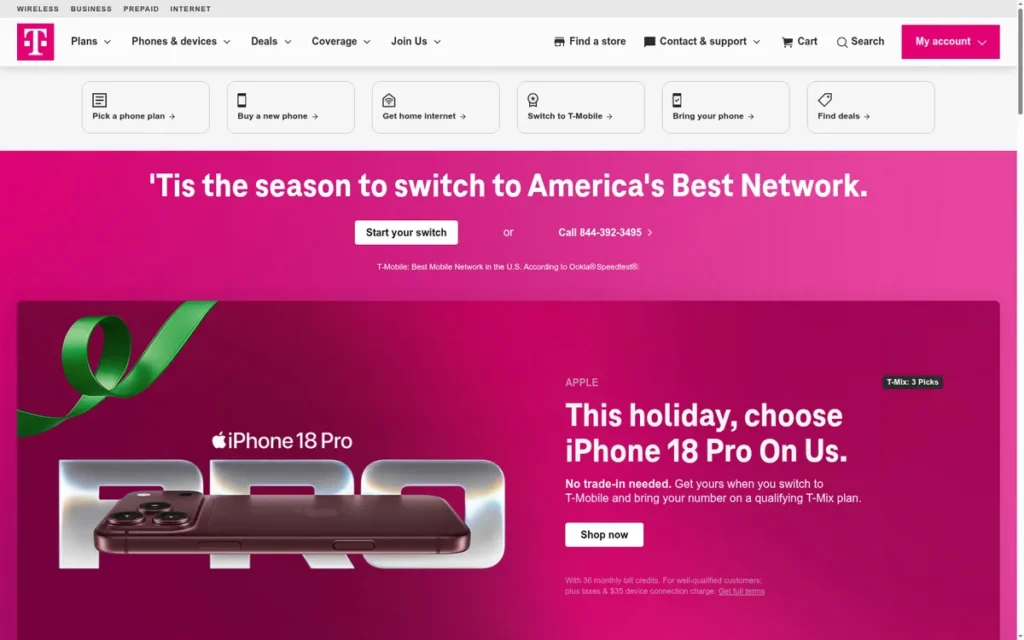
Category: 5G Home Internet, fixed wireless delivered over a cellular network to a home gateway.
At a Glance
- Category: 5G Home Internet
- Best For: Renters, budget households and T-Mobile phone customers who want no installation and a long price lock
- Price Range: $50–$70/month with AutoPay ($60–$80 without; lower with a T-Mobile voice line, though sources conflict) plus a one-time $35 device charge (checked November 2026)
- Primary Strength: T-Mobile 5G Home Internet combines self-setup with price locks of up to 10 years and the top J.D. Power 2026 wireless score.
- Biggest Limitation: T-Mobile 5G Home Internet has low median uploads, slows down when towers are busy, and uses carrier-grade NAT that can break work VPNs and port forwarding.
- One-Line Summary: T-Mobile 5G Home Internet is the best no-install Xfinity alternative in 2026, with plans from $50/month with AutoPay, price locks of up to 10 years and the top J.D. Power 2026 wireless score (659/1,000), though speeds vary by address and time of day.
- Last Verified: November 2026
Overview
T-Mobile 5G Home Internet is a fixed wireless access (FWA) service that delivers unlimited data over T-Mobile’s 5G network to a self-installed gateway. T-Mobile 5G Home Internet suits renters, budget households and T-Mobile customers who want to leave Xfinity without a technician visit.
T-Mobile 5G Home Internet performance depends on tower signal and capacity at each address. T-Mobile 5G Home Internet scored 33/50, the highest of the non-fiber options.
Key Features
- T-Mobile 5G Home Internet offers Rely (up to 354 down / 55 up Mbps), Amplified, and All-In (up to 498 / 55 Mbps) plans, and those speeds are advertised maximums.
- T-Mobile 5G Home Internet includes unlimited data, a gateway and no annual contract.
- T-Mobile 5G Home Internet locks prices for 5 years on Rely and Amplified and 10 years on All-In.
- T-Mobile 5G Home Internet is set up by the customer, who places and activates the gateway without a technician.
- T-Mobile 5G Home Internet eligibility is checked address by address, because service depends on local signal and spare tower capacity.
Best For
T-Mobile 5G Home Internet is best for renters, light-to-moderate users and T-Mobile phone customers who mostly download and stream and want a cheap, long-locked price.
Pricing
T-Mobile 5G Home Internet prices as of November 2026 are shown with AutoPay, without AutoPay and with a voice line (RSI, accessed Nov 2026; BroadbandNow, accessed Nov 2026):
- T-Mobile 5G Home Internet Rely costs $50, $60 or $35.
- T-Mobile 5G Home Internet Amplified costs $60, $70 or $45.
- T-Mobile 5G Home Internet All-In costs $70, $80 or $55.
T-Mobile 5G Home Internet charges a one-time $35 device connection fee. Another 2026 source describes a $20 voice-line discount, which would mean $30, $40 and $50, so confirm the voice-line rate at checkout.
Strengths
- T-Mobile 5G Home Internet earned the top score in the national wireless segment of the J.D. Power 2026 U.S. ISP Satisfaction Study, 659/1,000 (J.D. Power, 2026).
- T-Mobile 5G Home Internet scored 78/100 in ACSI 2026, unchanged from 2025 and 7 points above the 2026 non-fiber average of 71 (ACSI, 2026).
- T-Mobile 5G Home Internet’s 10-year price lock on All-In is the longest guarantee in this evaluation.
- T-Mobile 5G Home Internet users call setup “super fast and really easy,” and one user reported “I consistently get speed around the 500 with an upload speed around 50” (ISP Reports, accessed Nov 2026; u/Sufficient_Water_326, r/newjersey, accessed Nov 2026).
Limitations
T-Mobile 5G Home Internet’s most consequential trade-off is upload speed. Its median upload of 15.49 Mbps is below typical Xfinity uploads (Ookla Q3 2025 data, reported secondhand by Human-I-T, accessed Nov 2026).
- T-Mobile 5G Home Internet traffic gets lower priority when towers are busy, and one user saw speeds fall “as low as 1mbps” (u/flames_of_chaos, r/newjersey, accessed Nov 2026).
- T-Mobile 5G Home Internet uses carrier-grade NAT, which blocks port forwarding (ServeTheHome, accessed Nov 2026), and its locked gateway “did not play well with my work VPN” for one user (u/TheZapster, r/newjersey, accessed Nov 2026).
- T-Mobile 5G Home Internet latency can spike at peak times, which matters for video calls and gaming.
- T-Mobile 5G Home Internet’s price guarantee covers the plan price but excludes taxes and fees.
Users on r/tmobileisp noted:
“I always tell people either this service is amazing (I get 400-600Mbps download 20-50mbps upload speeds, I play COD in my PS5 without issues) or it sucks completely. There is no middle ground. Maybe check if they offer Fiber in your area (they offer it in mine but I’m happy paying 35 per month for TMHI).” Posted by u/ElijahARG
Takeaway: T-Mobile 5G Home Internet performs very differently from one address to the next, so a trial at your own home tells you far more than any average speed figure.
How Does T-Mobile 5G Home Internet Compare With Xfinity?
Xfinity’s current plans start at $55/month with a five-year price lock and unlimited data. T-Mobile 5G Home Internet starts below that price with AutoPay and offers a longer lock, up to 10 years. Xfinity’s wired connection gives faster, more consistent uploads and lower latency.
Verdict
T-Mobile 5G Home Internet is the highest-scoring non-fiber Xfinity alternative in this 2026 ranking (33/50), backed by the top J.D. Power 2026 wireless score (659/1,000) and price locks of up to 10 years. T-Mobile 5G Home Internet ranks above Verizon 5G Home Internet on Availability and True Cost (4 vs 3 on both). T-Mobile 5G Home Internet does not fix slow uploads, so VPN users should test it during the trial period.
6. Verizon 5G Home Internet: Best 5G Option for Verizon Phone Customers
Category: 5G Home Internet, fixed wireless delivered over a cellular network to a home gateway.
At a Glance
- Category: 5G Home Internet
- Best For: Verizon mobile customers who want a cheap, no-install alternative and strong customer support
- Price Range: $60–$85/month, or $35–$60/month with a qualifying Verizon mobile plan and AutoPay (verified November 2026)
- Primary Strength: Verizon 5G Home Internet pairs a top non-fiber ACSI 2026 score with highly rated customer support.
- Biggest Limitation: Verizon 5G Home Internet has low typical uploads, higher latency than cable, and a smaller coverage area than T-Mobile.
- One-Line Summary: Verizon 5G Home Internet is the best 5G Xfinity alternative for Verizon phone customers in 2026, costing $35–$60/month with a qualifying mobile plan and tying for the top non-fiber ACSI 2026 score (79/100), but with low uploads and higher latency than cable.
- Last Verified: November 2026
Overview
Verizon 5G Home Internet is a fixed wireless access (FWA) service that delivers unlimited home internet over Verizon’s C-band and mmWave 5G network. Verizon 5G Home Internet suits Verizon mobile customers who want a cheaper, no-install Xfinity replacement with well-rated customer support.
Verizon 5G Home Internet shares a parent company with Verizon Fios and Frontier Fiber. Verizon 5G Home Internet scored 31/50.
Key Features
- Verizon 5G Home Internet offers 5G Home, 5G Home Plus and 5G Home Ultimate tiers with unlimited data, an included router and no annual contract.
- Verizon 5G Home Internet guarantees prices for 3, 4 or 5 years, depending on the tier.
- Verizon 5G Home Internet uses C-band for wider coverage and mmWave (Ultra Wideband) for top speeds.
- Verizon 5G Home Internet offers an outdoor receiver at some addresses to improve the signal.
- Verizon 5G Home Internet drops to $35, $45 or $60 per month with a qualifying Verizon mobile plan and AutoPay.
Best For
Verizon 5G Home Internet is best for Verizon mobile customers who stream and browse more than they upload and value responsive customer support.
Pricing
Verizon 5G Home Internet lists these prices as of November 2026, with the qualifying-mobile-plan price shown second (Verizon, accessed Nov 2026):
- Verizon 5G Home Internet 5G Home costs $60 or $35, with a 3-year guarantee.
- Verizon 5G Home Internet 5G Home Plus costs $70 or $45, with a 4-year guarantee.
- Verizon 5G Home Internet 5G Home Ultimate costs $85 or $60, with a 5-year guarantee.
One user on r/verizon complained about being pushed onto the $85 Ultimate plan for what felt like the same service (r/verizon, 2026).
Strengths
- Verizon 5G Home Internet scored 79/100 in ACSI 2026, up 3% from 2025, tied for the top non-fiber score and 8 points above the non-fiber average of 71 (ACSI, 2026).
- Verizon 5G Home Internet received 86% overall satisfaction and 80% customer-support approval in CableTV.com’s Best of the Best awards, versus 80% and 71% for Xfinity (CableTV.com, 2025).
- Verizon 5G Home Internet’s 34.4 ms latency was the lowest among 5G providers in CableTV.com’s comparison (CableTV.com, 2025).
- Verizon 5G Home Internet can cut costs sharply: “it’s $50 for Verizon and Xfinity is costing me $115” (u/rueggy, r/verizon, 2022; dated thread).
Limitations
Verizon 5G Home Internet’s most consequential trade-off is upload speed. Verizon lists typical uploads of 5–20 Mbps, while CNET cites ceilings of 20, 35 and 75 Mbps, and these sources conflict.
- Verizon 5G Home Internet measured 34.4 ms latency, compared with 16.6 ms for Xfinity (CableTV.com, 2025).
- Verizon 5G Home Internet covers fewer homes than T-Mobile, and performance depends on signal and gateway placement (Reviews.org, accessed Nov 2026).
- Verizon 5G Home Internet dropped out “every 2-3 hours” for one user (u/Sensitive-Relief-881, r/verizon, 2022; dated thread).
- Verizon 5G Home Internet costs $60–$85 without a Verizon mobile plan, which can match or exceed Xfinity’s five-year-lock prices.
How Does Verizon 5G Home Internet Compare With Xfinity?
Xfinity’s current plans start at $55/month with a five-year price lock and unlimited data. Verizon 5G Home Internet beats Xfinity on support ratings and, for Verizon phone customers, on price. Xfinity offers lower latency and faster uploads over its wired line.
Verdict
Verizon 5G Home Internet is the best 5G alternative to Xfinity for Verizon phone customers in 2026, tying for the top non-fiber ACSI 2026 score (79/100) and costing as little as $35/month with a qualifying plan. Verizon 5G Home Internet ranks sixth because it scored 3 against T-Mobile’s 4 on both Availability and True Cost. Its low uploads make it a poor fit for heavy uploaders.
7. Starlink Residential: Best for Rural Homes and Backup Lines
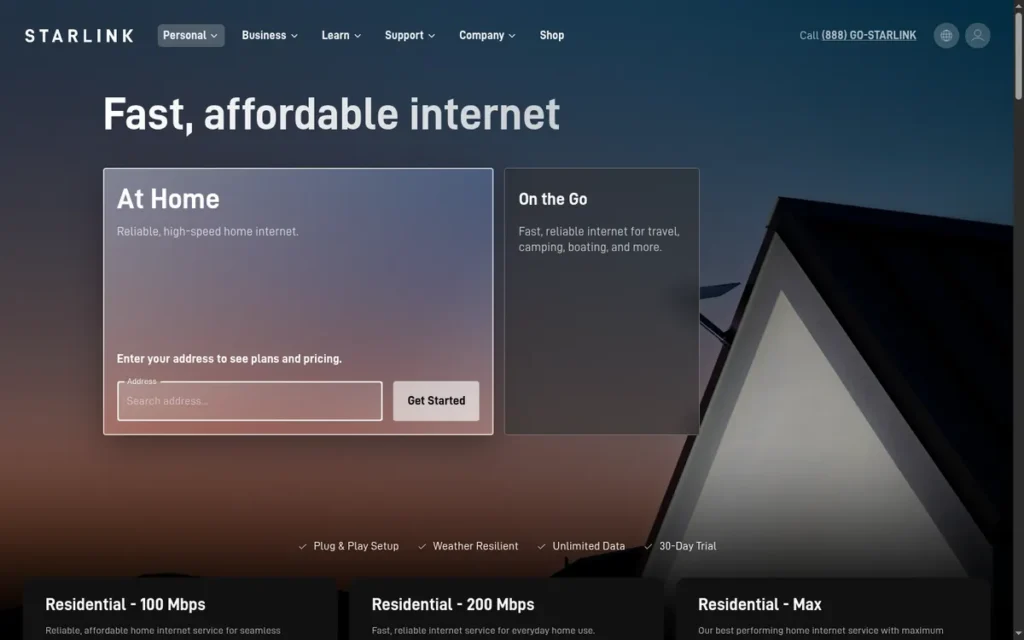
Category: LEO Satellite, internet delivered from low-Earth-orbit satellites to a dish at the home.
At a Glance
- Category: LEO Satellite
- Best For: Rural households without fiber or strong 5G, and remote workers who need a backup line
- Price Range: $55–$130/month plus $149–$349 hardware (free rental in select areas) and a possible $100–$1,500 congestion charge (checked November 2026; prices change often)
- Primary Strength: Starlink Residential reaches almost any address with a clear view of the sky and has far lower latency than older satellite services.
- Biggest Limitation: Starlink Residential costs more per megabit than wired options, with high upfront hardware costs, possible congestion fees and weaker uploads.
- One-Line Summary: Starlink Residential is the best Xfinity alternative for rural homes and backup lines in 2026, delivering a 127 Mbps median download at 39 ms latency (Ookla, Q1 2026), but it costs more per megabit than fiber or 5G where those are available.
- Last Verified: November 2026
Overview
Starlink Residential is SpaceX’s low-Earth-orbit (LEO) satellite internet service, with unlimited-data plans from $55/month and advertised latency of 30–40 ms. Starlink Residential suits rural households with few wired options and remote workers who want a backup line independent of cable.
Starlink Residential needs a clear view of the sky. Starlink Residential scored 30/50.
Key Features
- Starlink Residential offers 100 Mbps, 200 Mbps and MAX (up to 400 Mbps) plans with unlimited data (SatelliteInternet.com, 2026).
- Starlink Residential runs on a low-Earth-orbit constellation with laser links between satellites, and about 7,550 V2 Mini satellites had launched by October 2026 (Fierce Network, 2026).
- Starlink Residential has no annual contract on standard plans.
- Starlink Residential also offers Residential Lite (speed-limited) and Roam (mobile) plans.
- Starlink Residential provides support through its app and a ticket system.
Best For
Starlink Residential is best for rural households that no fiber or reliable 5G reaches, and for remote workers who want a backup connection during cable outages.
Pricing
Starlink Residential lists these monthly prices in late-2026 reports (SatelliteInternet.com, 2026):
- Starlink Residential 100 Mbps costs $55/month.
- Starlink Residential 200 Mbps costs $85/month.
- Starlink Residential MAX costs $130/month.
Starlink Residential’s standard kit costs $349, with free rental in select areas, and the Mini costs $149–$349. Starlink Residential may also add a one-time congestion charge of $100–$1,500 in busy areas (BudgetSeniors, accessed Nov 2026).
Users earlier in 2026 reported paying $120 for unlimited and $80 for Lite, so confirm the price at checkout.
Strengths
- Starlink Residential recorded a 127.39 Mbps median download and 39 ms latency, compared with HughesNet at 48.55 Mbps and 674 ms and Viasat at 41.05 Mbps and 750 ms (Ookla, Q1 2026).
- Starlink Residential’s U.S. median upload reached 20.73 Mbps (Ookla H1 2026 data via Fierce Network, 2026).
- Starlink Residential entered the ACSI ranking for the first time in 2026 at 76/100, matching the fiber-segment average and 5 points above the non-fiber average of 71 (ACSI, 2026).
- Starlink Residential can keep remote workers online through cable outages: “Xfinity went down in my neighborhood for 7hrs last week and we didn’t miss a beat” (u/Key-Opposite5453, r/Starlink, accessed Nov 2026).
Limitations
Starlink Residential’s most consequential trade-off is value. Starlink Residential delivers less speed per dollar than fiber or 5G and adds $149–$349 in hardware plus possible congestion charges.
- Starlink Residential slows down because of trees, rain, snow and busy hours, and in one example speeds fell from about 200 Mbps to 50–80 Mbps (FindBetterInternet, accessed Nov 2026).
- Starlink Residential latency can affect calls: “it’s simply not great for when I need to take a Teams call” (u/MIDIHorse, r/Starlink, accessed Nov 2026).
- Starlink Residential’s free hardware in select areas often comes with a 12-month commitment.
- Starlink Residential support is app- and ticket-only, with reply times reported from the same day to a week.
How Does Starlink Residential Compare With Xfinity?
Xfinity’s current plans start at $55/month with a five-year price lock and unlimited data. Starlink Residential reaches homes Xfinity’s cable can’t and keeps working during cable outages. Xfinity offers lower latency and more speed for the money wherever cable is available: “Starlink is only worth it if you’re in a very rural area” (u/flames_of_chaos, r/newjersey, accessed Nov 2026).
Verdict
Starlink Residential is the best Xfinity alternative for rural homes without fiber or strong 5G and for households that need a backup line, delivering a 127 Mbps median download at 39 ms latency (Ookla, Q1 2026). Starlink Residential’s median latency was about 17 times lower than HughesNet’s 674 ms in the same data. Starlink Residential ranks seventh on overall value, but for addresses with no fiber or 5G, it is often the only realistic option.
Why Are People Leaving Xfinity, and What Does Xfinity Offer Now?
People leave Xfinity mainly over price increases, slow cable uploads and legacy data caps. Xfinity has responded with a five-year price guarantee from $55/month and unlimited data with an included gateway on new plans. Even so, Comcast lost 178,000 residential broadband customers in Q4 2025 (Comcast Q4 2025 earnings, 2026; Ars Technica, 2026).
Xfinity’s current offer, according to the sources cited:
- Price lock: Comcast launched a five-year price guarantee with plans from $55/month in April 2025 (Reuters, 2025).
- Plans: Comcast moved to four national tiers from $55 to $115/month, covering 300 Mbps to 2 Gbps, all with unlimited data and an included gateway (Ars Technica, 2025).
- Legacy caps: Some older Xfinity plans still carry a 1.2 TB data cap with overages of $10 per 50 GB, up to $100/month, mostly in Central and Western markets (MyUtilitySearch, accessed Nov 2026).
- G2 rating: Xfinity holds 3.7/5 on G2 from 19 reviews, with 73.7% rating it 4 or 5 stars, and G2 lists no pros, cons or prices for Xfinity (G2, 2026).
Cable networks using DOCSIS traditionally reserve far less capacity for uploads than downloads. That is why Xfinity gig plans can upload at about 35 Mbps unless the area has a mid-split upgrade.
A 10 GB video or backup file shows the gap in practice:
- At 35 Mbps, a typical Xfinity gig upload reported by users, a 10 GB upload takes about 38 minutes.
- At 15.5 Mbps, T-Mobile 5G Home Internet’s 2025 median, the same upload takes about 86 minutes.
- At 940 Mbps on symmetrical fiber, the same upload takes under 2 minutes.
“Comcast is 1gb down and only like 35mbps up.” (u/jtbis, r/Fios)
Takeaway: On many Xfinity gig plans, upload speed is a small fraction of download speed, and that is the gap fiber is built to close.
Complaints differ by connection type, according to a 2026 analysis of more than 4,000 Reddit posts (The Desk, 2026):
- Price came up in 32% of cable posts.
- Price came up in 21% of fiber posts.
- Price came up in 7% of fixed-wireless posts.
- Speed came up in 37% of fixed-wireless posts, which shows the trade-off 5G buyers face.
These figures are shares of social posts, not a representative survey.
“Comcast/Xfinity raises your price every year or so, unless you threaten to cancel it and renegotiate.” (u/mister_drgn, r/Fios)
Takeaway: Xfinity bills can rise over time unless you negotiate, so get the regular rate and the guarantee terms in writing from any provider.
How Do These Alternatives Compare With Xfinity on Cost and Terms?
Several fiber alternatives start below Xfinity’s $55 entry price, but usually only with AutoPay or a 12-month promotion. Every fiber option advertises faster uploads than Xfinity cable. The 5G options cost less with a phone line but upload more slowly, and Starlink Residential costs the most upfront. Conflicting or secondhand figures are marked with an asterisk.
| Provider | Parent Company | Technology | Starting Price (Nov 2026) | Price After Promo | Upload | Data Cap | One-Time Fees | Guarantee Length | Independent Rating (Scale) |
|---|---|---|---|---|---|---|---|---|---|
| Xfinity (baseline) | Comcast | Cable | $55 | Locked tiers $55–$115 | 35–300 Mbps (user-reported) | None on new plans | Not verified | 5 years | G2 3.7/5 (19 reviews) |
| AT&T Fiber | AT&T | Fiber | $35 for 300 Mbps (12-month promo, Allconnect 2026)*; $100 for 5 Gig (AT&T, verified) | ~$50 (300 Mbps); $135 (5 Gig) | Symmetrical (advertised) | None | Not verified | No multi-year guarantee found (12-month promotional rate) | ACSI 79/100 |
| GFiber | Alphabet | Fiber | $70 (1 Gig) | No promo; same price (taxes and local access fee may be extra) | Symmetrical (advertised) | None | Standard install free | Flat pricing (company claim) | J.D. Power 707/1,000 (South) |
| Frontier Fiber | Verizon | Fiber | $44.99 (500 Mbps) with AutoPay; 200 Mbps at $29.99 may be unavailable to new customers* | $10 more without AutoPay | Symmetrical (advertised) | None | Install included on 500 Mbps+ | 4–5 years | J.D. Power 604/1,000 (South) |
| Verizon Fios | Verizon | Fiber | $30 with AutoPay (Verizon main Fios page, Nov 2026)* | Not verified | Near-symmetrical (advertised) | None | Setup up to $99 | 3–5 years (base rate only) | J.D. Power 592/1,000 (East, #1; all Verizon wired) |
| T-Mobile 5G Home | T-Mobile | 5G FWA | $50 with AutoPay* | Locked | 15.5 Mbps (Ookla median, Q3 2025, secondhand) | None | $35 device charge | 5 or 10 years (taxes and fees excluded) | J.D. Power 659/1,000 (wireless); ACSI 78/100 |
| Verizon 5G Home | Verizon | 5G FWA | $60 ($35 with Verizon mobile) | Locked | 5–20 Mbps (Verizon typical, advertised)* | None | Not verified | 3–5 years | ACSI 79/100 |
| Starlink Residential | SpaceX | LEO satellite | $55 plus hardware | Prices change often | 20.7 Mbps (Ookla median, H1 2026) | None on Residential plans | $149–$349 hardware; $100–$1,500 congestion charge | None verified | ACSI 76/100 |
*Figure is secondhand or conflicts across sources. Another Verizon page lists Fios 300 Mbps at $40. T-Mobile voice-line prices and Verizon 5G Home upload figures differ between sources. Confirm at checkout.
Which Xfinity Alternatives Actually Serve My Address?
The only reliable way to know which Xfinity alternatives serve your home is to check your exact street address. Start with the FCC National Broadband Map, then confirm on each provider’s own address checker. A ZIP code, a coverage map or a neighbor’s service does not guarantee a provider can install at your home.
Follow these steps:
- Step 1: Search your address on the FCC National Broadband Map, which shows the providers that report service there.
- Step 2: Enter the same address on each provider’s own availability checker, because the FCC map does not confirm that a provider can actually install.
- Step 3: Compare FCC Broadband Labels for plan details, keeping in mind that these labels do not guarantee how long a promotion lasts.
A “36 million locations” footprint includes businesses and partner sites, so a provider can reach your city while skipping your street. That is why the address check comes first.
Spectrum and Cox are not in this ranking. Both are cable providers whose footprints rarely overlap with Xfinity’s, so they are usually not an option at an Xfinity address.
Quantum Fiber is no longer a separate choice. AT&T Fiber absorbed Lumen’s Quantum Fiber markets when the deal closed on February 2, 2026 (AT&T, 2026).
Can 5G Home Internet Replace a Wired Xfinity Line?
5G home internet can replace Xfinity for households that mostly download and stream, but it often isn’t a good fit for heavy uploaders or remote workers who use a VPN. Median uploads and latency were worse than cable in the data reviewed. Speeds also vary a lot by address and time of day.
5G home internet is a download service with a modest upload. T-Mobile 5G Home Internet’s 2025 median upload of about 15.5 Mbps is less than half the roughly 35 Mbps that Xfinity gig users report.
Key performance gaps for 5G home internet:
- Upload: T-Mobile 5G Home Internet’s median upload was 15.49 Mbps (Ookla Q3 2025 data, reported secondhand), and Verizon lists typical 5G Home uploads of 5–20 Mbps.
- Latency: Verizon 5G Home Internet measured 34.4 ms, compared with 16.6 ms for Xfinity (CableTV.com, 2025).
- Network management: T-Mobile 5G Home Internet traffic gets lower priority when towers are busy.
- Remote access: 5G home internet services that use carrier-grade NAT block port forwarding, and locked gateways can interfere with work VPNs.
Test 5G home internet at your own address during the trial period, before you cancel Xfinity. Run three tests:
- Hold a 30-minute video call between 7 and 9 p.m., when towers are busiest.
- Connect to your work network over your VPN and confirm it stays stable.
- Run a speed test at three different times of day and compare the upload results.
When Does Staying With Xfinity Make Sense?
Staying with Xfinity makes sense when no fiber serves your address, when your area has upgraded cable with faster uploads, or when Xfinity’s retention offer beats a competitor’s quote. Xfinity’s five-year lock and unlimited data on new plans have removed two of the most common reasons people leave.
Stay with Xfinity if any of these apply:
- No fiber: Neither the FCC map nor any fiber provider’s checker confirms fiber at your address.
- Upgraded network: Your area has mid-split or X-Class cable upgrades, which Reddit users say bring faster uploads.
- Good lock: Xfinity offers you a five-year price lock in the $55–$65 range with unlimited data.
- Latency needs: You need lower latency than 5G or satellite, since wired connections showed lower latency in the data reviewed (Xfinity 16.6 ms vs Verizon 5G Home Internet 34.4 ms, CableTV.com, 2025).
- Better retention offer: Xfinity counters a competitor’s quote, which users report but which isn’t guaranteed.
One Reddit user who called to cancel was offered “2 gig speed with no cap and price locked for 5 years. It was better, faster, and cheaper than the ATT offer” (u/FridayMcNight, r/bayarea, accessed Nov 2026). Customers on legacy plans should check whether the 1.2 TB cap still applies to them.
How Do I Switch From Xfinity Without Losing Internet?
To switch from Xfinity without losing internet, confirm the new service at your exact address first. Keep Xfinity active until the new connection is installed and tested, and only then cancel. After canceling, return Xfinity’s equipment and check your final bill, because cancellations don’t always process cleanly on the first try.
- Check the FCC National Broadband Map for providers that report service at your address.
- Confirm on the provider’s address checker and get a written quote that shows the price after the promotion ends.
- Compare FCC Broadband Labels for fees, guarantee length and data policy.
- Ask Xfinity for a retention offer using the competitor’s quote.
- Schedule installation while Xfinity stays active, because fiber installs can take weeks.
- Test during the trial period with video calls, VPN sessions and evening speed tests.
- Cancel Xfinity, return the equipment and review the final bill. One Reddit user reported it took Xfinity two months to fully turn off service.
What Red Flags Should I Watch For When Evaluating Xfinity Alternatives?
The biggest red flags when comparing Xfinity alternatives fall into two groups: costs that appear after you sign, and technical or coverage claims nobody has confirmed for your address. Either kind can wipe out the savings you switched for. The six red flags below are the patterns that came up most often in the 2026 research.
Red Flag #1: Promo Price With No Stated Regular Rate A quote that leaves out the price after the promotion hides your real long-term cost. AT&T Fiber’s verified 5 Gig plan, for example, rises from $100 to $135/month after 12 months. Always add up the second year before you compare quotes from different providers.
Over 24 months, AT&T Fiber’s 5 Gig plan costs about $2,820 before taxes ($100 × 12, then $135 × 12). GFiber’s 3 Gig plan costs $2,400 ($100 × 24) at a flat rate.
Red Flag #2: Conditional Discounts (AutoPay or Phone Line Required) Advertised home internet prices often assume AutoPay, paperless billing or a mobile bundle. Frontier Fiber prices rise $10 without AutoPay, and Verizon 5G Home Internet’s $35 price requires a qualifying Verizon mobile plan. Ask for the price without each condition before you sign.
Red Flag #3: Price Guarantee That Excludes Equipment and Perks Some price guarantees cover only the base rate, so your bill can still go up. Verizon Fios’s 3- to 5-year guarantee excludes equipment, perks and promotions. T-Mobile 5G Home Internet’s guarantee excludes taxes and fees. Read the exclusions before you treat a lock as a fixed bill.
Red Flag #4: Locked Gateway or Carrier-Grade NAT for VPN Users Locked gateways and carrier-grade NAT can block port forwarding and break work VPNs. Users report these problems with T-Mobile 5G Home Internet, and AT&T Fiber’s gateway lacks a true bridge mode. Remote workers should confirm gateway control before canceling a working wired line.
Red Flag #5: One-Time Hardware, Device or Congestion Charges Upfront charges can change the math in year one, even when the monthly price looks lower. Add these fees to your first-year total:
- T-Mobile 5G Home Internet charges a one-time $35 device connection fee.
- Starlink Residential hardware costs $149–$349, plus a possible $100–$1,500 congestion charge.
- Verizon Fios may charge a setup fee of up to $99.
Red Flag #6: Coverage Map Listing Without Address Confirmation A coverage map or FCC listing doesn’t confirm that a provider can install at your home. Only the provider’s address checker and a written order confirmation show you can actually get service. Treat any provider without that confirmation as unavailable until proven otherwise.
What Questions Should I Ask Before Choosing an Xfinity Alternative?
Before choosing an Xfinity alternative, ask questions that turn advertised claims into confirmed terms for your address. The answers should confirm both the long-term price and the real-world performance you’ll get. The six questions below cover most of the risk in switching, and each one takes only a short call or chat to answer.
Question #1: Does this provider confirm service at my exact address, not just my ZIP code? Look for a confirmation tied to your street address, ideally in writing. Treat ZIP-level or map-level answers as unconfirmed. A provider can serve your neighborhood and still skip your building, so don’t cancel Xfinity until an installation date is booked.
Question #2: What is the regular monthly price after the promotion ends? Ask for the regular rate, how long the guarantee lasts, and what it leaves out. Then add up AutoPay conditions, equipment fees and one-time charges. Comparing two-year totals, not first-month prices, is the most reliable way to see which provider actually costs less.
Question #3: What upload speed will I actually get? Ask for typical speeds, not just the advertised maximum. Fiber providers advertise symmetrical tiers. The 5G and satellite medians in this research ran from about 15 to 21 Mbps. If you upload video or back up to the cloud, upload speed matters more than download speed.
Question #4: Will it work with my work VPN, and do I get bridge mode? Ask whether the gateway supports bridge mode or IP Passthrough, and whether the network uses carrier-grade NAT. Remote workers should confirm both before canceling Xfinity. If support can’t answer clearly, test your VPN during the trial period before you depend on the connection.
Question #5: Is there a trial period so I can test it before canceling Xfinity? Ask how long you have to return the equipment or cancel without a penalty. Use that time to test during peak evening hours, when congestion is most likely. Keep Xfinity active until the trial confirms the new service handles your real workload.
Question #6: What would Xfinity offer me to stay? Call Xfinity with your competitor’s written quote before canceling. Reddit users report retention offers that beat the alternatives, sometimes with faster speeds and five-year locks. These offers aren’t guaranteed, but asking costs nothing and gives you a firm baseline to compare against.
How Did We Rank These Xfinity Alternatives?
Weigh Apps scored seven Xfinity alternatives from 1 to 5 on six criteria. Four primary criteria count double and two secondary criteria count once, for a maximum of 50 points. Availability is scored rather than used as a filter, so a top-rated regional provider like GFiber can rank below a provider with wider reach.
Primary criteria (counted twice):
- Independent Customer Satisfaction (2026): This criterion uses ACSI 2026 and J.D. Power 2026 scores, because readers want proof that an alternative is better, not marketing claims.
- Upload Speed and Performance Fix: This criterion favors measured speeds over advertised ones, because slow cable uploads are a top reason people switch.
- True Cost and Price Transparency: This criterion weighs prices after promotions, conditional discounts, one-time fees and conflicting published prices.
- Realistic Availability to Xfinity Households: This criterion scores reported footprints, because an alternative only helps if it reaches your address.
Secondary criteria (counted once):
- Contract, Data Cap and Equipment Terms: This criterion checks caps, commitments, included equipment and gateway control.
- Reliability and Switching Friction: This criterion looks for patterns in dated user reports about installation, outages and support.
| Rank | Provider | Satisfaction | Upload | True Cost | Availability | Terms | Reliability | Total /50 |
|---|---|---|---|---|---|---|---|---|
| 1 | AT&T Fiber | 4 | 5 | 3 | 5 | 4 | 3 | 41 |
| 2 | GFiber | 4 | 5 | 5 | 1 | 5 | 4 | 39 |
| 3 | Frontier Fiber | 3 | 5 | 4 | 3 | 4 | 2 | 36 |
| 4 | Verizon Fios | 3 | 4 | 3 | 3 | 4 | 4 | 34 |
| 5 | T-Mobile 5G Home Internet | 4 | 2 | 4 | 4 | 3 | 2 | 33 |
| 6 | Verizon 5G Home Internet | 4 | 2 | 3 | 3 | 4 | 3 | 31 |
| 7 | Starlink Residential | 3 | 2 | 2 | 5 | 3 | 3 | 30 |
Weigh Apps re-checked the True Cost scores in November 2026 against new pricing evidence for AT&T Fiber, Frontier Fiber and Verizon Fios. No score changed.
How the close calls were decided:
- Frontier Fiber vs Verizon Fios: Frontier Fiber (36/50) ranks above Verizon Fios (34/50) because it scored higher on Upload (5 vs 4) and True Cost (4 vs 3), both double-weighted. Those gains outweighed Verizon Fios’s stronger Reliability score (4 vs 2). Both scored 3 on Availability.
- Satisfaction scores: Verizon Fios scores 3 because its J.D. Power East win covers all Verizon wired service and no Fios-specific ACSI score was found. AT&T Fiber scores 4 for two regional J.D. Power wins plus the top ACSI fiber score.
Rating scales differ and shouldn’t be compared directly:
- ACSI scores run from 0 to 100, are national, and reflect surveys collected from April 2025 through March 2026 (ACSI, 2026).
- ACSI 2026 averages were 76 for fiber and 71 for non-fiber providers, and GFiber and Verizon Fios have no ACSI 2026 score.
- J.D. Power scores run from 0 to 1,000 and are regional or segment-specific.
- G2 has data only for Xfinity (3.7/5 from 19 reviews, a small sample), so no G2 figures are used for the alternatives.
These data points remain unverified or conflicting:
- Trustpilot and BBB scores could not be verified for any provider.
- Independent speed tests from Ookla or the FCC were not found for most fiber providers.
- AT&T Fiber prices below 5 Gig come only from a secondhand source.
- Verizon Fios prices differ between two Verizon pages.
- Frontier Fiber’s 200 Mbps tier may no longer be sold to new customers.
- T-Mobile voice-line prices and Verizon 5G Home speed figures differ between sources.
No peer-reviewed studies were available for this category.
Weigh Apps has no affiliate relationships with any company listed. Rankings are determined entirely by research data and objective evaluation criteria.
What Do Readers Ask Most About Xfinity Alternatives?
Readers most often ask which Xfinity alternative is best overall and which ones have no data cap. They also ask how Weigh Apps decides its rankings. Each answer below starts with the direct answer and uses the same November 2026 data as the rest of this guide, so you can read any one of them on its own.
What is the best Xfinity alternative in 2026?
AT&T Fiber is the best overall Xfinity alternative in 2026 for households that can get it. AT&T Fiber scored 41/50 in Weigh Apps’ ranking, with symmetrical speeds up to 5 Gig and the highest fiber score in ACSI 2026 (79/100). GFiber ranks second for predictable pricing, and Frontier Fiber offers the lowest long-term fiber prices.
Which Xfinity alternatives have no data cap?
All seven ranked Xfinity alternatives list unlimited data on their residential plans as of November 2026, and Xfinity’s new plans are unlimited too. The exceptions are some legacy Xfinity plans, which still carry a 1.2 TB cap, and Starlink’s Roam plans, which include 100 GB and 300 GB tiers.
- AT&T Fiber has no data cap on its fiber plans.
- GFiber includes unlimited data on all three plans.
- Frontier Fiber includes unlimited data on its fiber plans.
- Verizon Fios includes unlimited data on every tier.
- T-Mobile 5G Home Internet includes unlimited data on all plans.
- Verizon 5G Home Internet includes unlimited data on all tiers.
- Starlink Residential includes unlimited data on Residential plans, while its Roam plans have data limits.
How does Weigh Apps determine rankings?
Weigh Apps scores each provider from 1 to 5 on six criteria, giving double weight to satisfaction, upload performance, true cost and availability, for a maximum of 50 points. Weigh Apps publishes the full scoring matrix, labels every rating with its scale and region, and lists unverified or conflicting data instead of guessing.
What Do Key Home Internet Terms Mean?
The home internet terms that matter most when leaving Xfinity are symmetrical speeds, latency, data caps, price guarantees, carrier-grade NAT and bridge mode. These terms decide whether a cheaper plan will handle video calls, VPNs and heavy uploads, and whether the advertised price is the price you will actually pay.
Symmetrical speeds: Symmetrical speeds mean upload and download speeds are the same. Symmetrical speeds matter for video calls, cloud backups and sending large files.
Fixed wireless access: Fixed wireless access is home internet delivered over a cellular network to a gateway inside your home. Fixed wireless access needs no wired installation, but performance depends on signal strength and how busy the local tower is.
LEO satellite: LEO satellite internet comes from satellites in low Earth orbit. LEO satellites orbit close to Earth, so latency is much lower than with older geostationary satellite service, which makes LEO more practical for real-time use.
Latency: Latency is the delay, in milliseconds, before data starts moving. Lower latency makes video calls, gaming and remote desktop work feel smoother.
Data cap: A data cap is a monthly limit on how much data you can use, with overage fees after you pass it. Heavy-use households should confirm a plan has no data cap before signing.
Price guarantee: A price guarantee is a promise that the monthly rate won’t change for a set period. Buyers should check what a price guarantee leaves out, such as equipment, perks, taxes or fees.
Carrier-grade NAT: Carrier-grade NAT is a setup where many customers share one public IP address. Carrier-grade NAT can block port forwarding and interfere with some VPNs, game servers and remote-access tools.
Bridge mode: Bridge mode is a gateway setting that passes the connection directly to your own router. Without bridge mode, people who want full control of their network may need workarounds like IP Passthrough.
Deprioritization: Deprioritization is when a network slows some traffic during congestion. On fixed wireless, deprioritization can lower home internet speeds at busy times like evenings.
Mid-split upgrade: A mid-split upgrade is a cable network upgrade that sets aside more capacity for uploads. A mid-split upgrade in your area can raise cable upload speeds enough to change whether you need to switch.
FCC Broadband Label: An FCC Broadband Label is a standardized disclosure of a plan’s price, fees and typical speeds. An FCC Broadband Label helps you compare plans, but it doesn’t guarantee how long a promotion lasts.
Fiber passings: Fiber passings are the number of locations a fiber network can reach. Fiber passings can include business and partner sites, so a large passings figure doesn’t mean every home is served.
Which Xfinity Alternative Is Right for You?
Key Insights
- Fiber is the first thing to check at your exact address, because fiber is the category most likely to fix Xfinity’s slow uploads, with symmetrical tiers from every fiber provider ranked here.
- AT&T Fiber leads on reach, GFiber on predictable pricing, and Frontier Fiber on the lowest long-term fiber cost in this 2026 ranking.
- 5G home internet from T-Mobile or Verizon makes sense only if you can accept variable speeds, low uploads and possible VPN problems.
- Starlink Residential is the realistic choice for rural homes without fiber or strong 5G, and a useful backup line for remote workers.
- The cheapest Xfinity alternative is sometimes Xfinity itself, since Reddit users report retention offers that beat competitors’ quotes, though these offers aren’t guaranteed.
Your phone carrier can also guide the choice. Verizon customers should compare Verizon Fios and Verizon 5G Home Internet bundles. T-Mobile customers should check T-Mobile 5G Home Internet’s voice-line pricing.
Everyone should get an Xfinity retention quote before canceling. Prices change often in this category, especially for Starlink and for Frontier under Verizon. We update this guide quarterly. Last updated: November 2026.
Read our full ranking methodology or browse Weigh Apps’ other independent internet provider reviews.